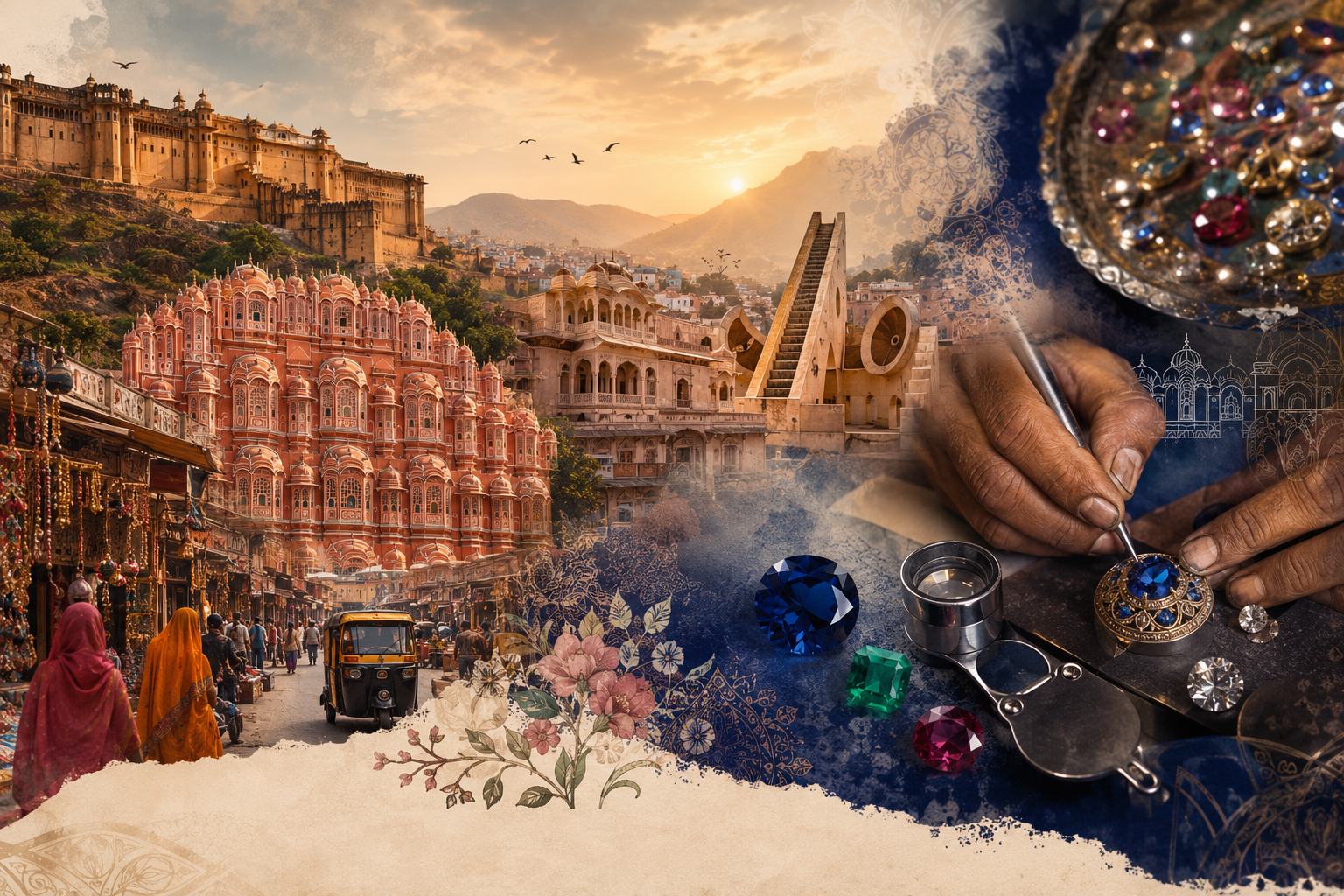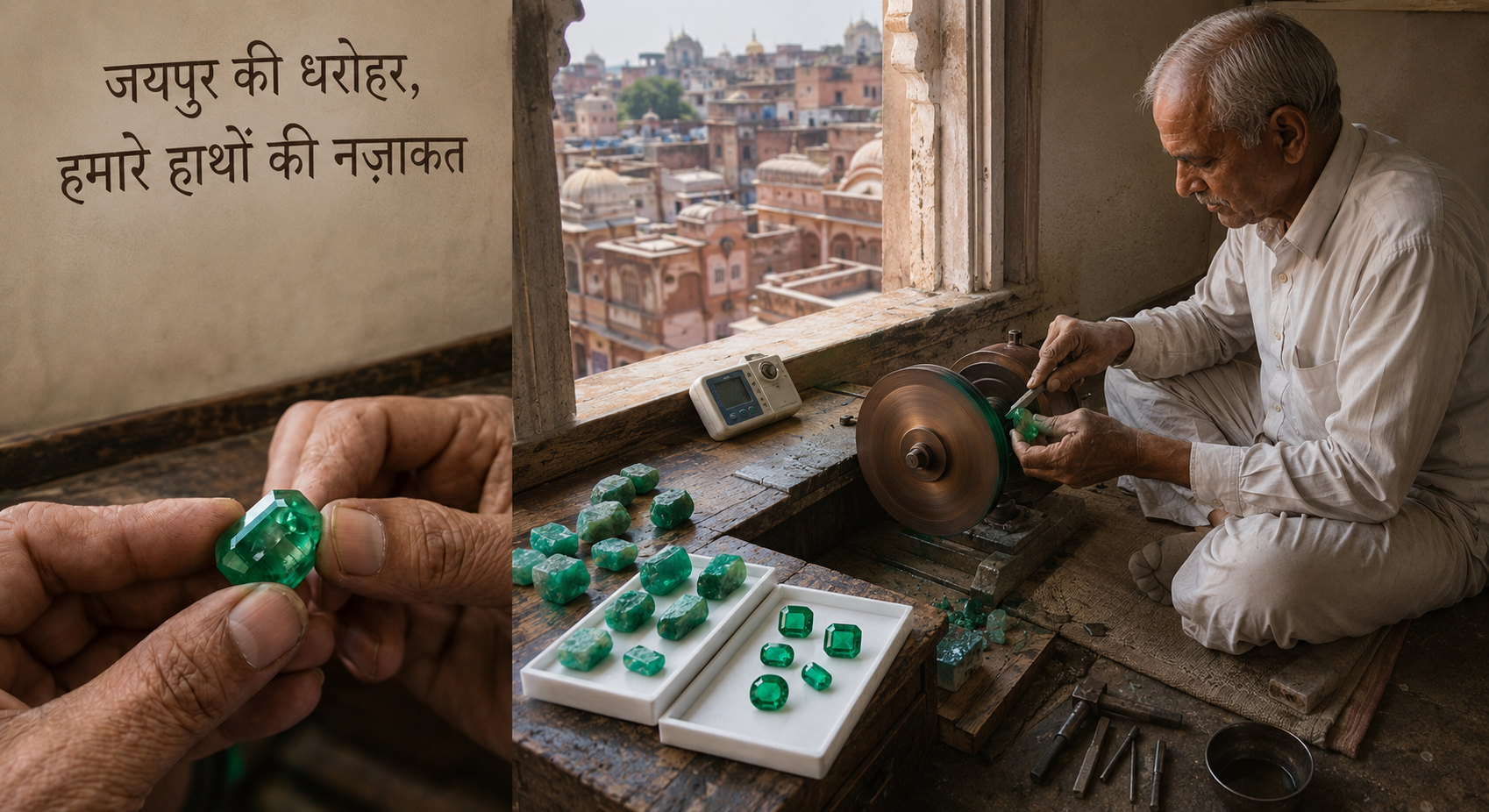
Jaipur is the world capital of emerald cutting. Stones arrive here as rough crystals from mines in Colombia, Zambia, Brazil, and Afghanistan, and leave as precisely faceted gems destined for jewellery workshops and auction houses across the globe. If you are buying an emerald in Jaipur — or anywhere, really — understanding what makes a genuine, quality stone is knowledge that will serve you for a lifetime. This guide covers what to look for, what to ask, and what the common traps are.
Why Jaipur and emeralds have a 300-year relationship
Emeralds first arrived in India in significant quantities during the Mughal period, imported from the new Spanish colonial mines in Colombia. The Mughal emperors had an extraordinary appetite for them — Emperor Aurangzeb's personal emerald, the size of a fist, is now in a museum in Tehran. Rajput craftsmen in Jaipur became the primary cutters and setters of these stones, developing techniques that are still in use today. The so-called 'Jaipur cut' — a style of faceting that maximises the depth and evenness of colour — is recognised by dealers worldwide.
The four things that determine an emerald's value
Emeralds are graded on the same four criteria as all coloured gemstones, but with some specific nuances that matter particularly for this stone.
Colour is the dominant factor. The finest emeralds have a pure, vivid green with a slight bluish undertone — what the trade calls 'Colombian green' even when the stone is from Zambia or Brazil. Stones that lean too yellow, too grey, or too dark lose value significantly. When you look at an emerald, the colour should be even throughout, without patches of lighter or darker tone.
Clarity is where emeralds differ most from other gems. Almost all natural emeralds contain inclusions — internal fractures, crystal inclusions, and growth patterns that the French trade calls 'jardin', meaning garden. Unlike diamonds, where inclusions are considered defects, emerald inclusions are accepted as part of the stone's identity. A completely eye-clean emerald is extraordinarily rare and priced accordingly. What you are looking for is a stone where the inclusions do not break the surface, do not affect the structural integrity of the stone, and do not interrupt the evenness of colour when viewed face-up.
Almost all natural emeralds contain inclusions — internal fractures that the French trade calls 'jardin', meaning garden. Unlike diamonds, this is expected and accepted. A completely eye-clean emerald is extraordinarily rare.
Cut determines how the stone presents its colour. A well-cut emerald reflects light evenly across its face. A poorly cut stone will have 'windowing' — a pale, transparent area in the centre where light passes through rather than reflecting back. Look at the stone face-up under a light source. If you can see through the middle of it clearly, the cut is too shallow.
Carat weight affects price significantly. Emeralds of over 3 carats with good colour and clarity are genuinely rare, and price per carat rises steeply as size increases. For a good quality stone in the 1–2 carat range, expect to pay substantially more per carat than for a comparable stone at 0.5 carats.
Understanding treatments — what to ask
This is the most important topic for any emerald buyer in Jaipur, and it is the one most commonly glossed over by sellers who are less than straightforward.
Almost all emeralds on the market have been treated with oil or resin to fill surface-reaching fractures and improve the apparent clarity of the stone. This is a longstanding, accepted, and disclosed practice in the gem trade — provided it is disclosed. The degree of treatment matters: a stone with 'minor' or 'faint' oiling is closer to its natural state and more valuable than one with 'moderate' or 'significant' oiling.
Always ask Has this stone been treated? What type of treatment? Is there a laboratory certificate? A reputable seller will answer all three questions without hesitation. If they are evasive, walk away.
A certificate from a recognised gemological laboratory — GIA, Gübelin, or SSEF — will state both the origin of the stone and the degree of any treatment. In Jaipur's better establishments, certification for stones above a certain value is standard practice. For lower-value stones, ask for the seller's own written guarantee.
Synthetic and simulant emeralds — the traps
The tourist jewellery market in Jaipur, as in any major gem city, contains a range of stones that are sold under the name 'emerald' without being genuine. The most common category is glass-filled stones — natural emerald crystals with very poor colour and clarity that have been heavily filled with green-tinted glass or resin. They can look attractive in a shop light, but will appear dull and lifeless in natural daylight.
Synthetic emeralds — created in a laboratory using the same chemical composition as natural stones — are another category. A synthetic emerald is not a fraud: it is a genuine emerald, chemically speaking. But it should be priced accordingly, which in practice means a small fraction of what a natural stone of the same size and colour would cost. If you are offered a vivid, clear emerald at a price that seems too good to be true, ask directly: is this natural or synthetic?
Green glass, green tourmalines, green grossular garnets, and green quartz are also sometimes sold as emerald to the less informed buyer. The simplest test is the refractive index, measurable with a refractometer — a tool any serious dealer will have on the counter. If a seller resists testing, that resistance is itself the answer.
Buying in Jaipur — practical guidance
The most reliable approach is to buy from an established dealer with a physical address, a recognisable reputation, and the willingness to provide written documentation with your purchase. Johari Bazaar contains both excellent established houses that have traded for generations and street-level operations that rely on tourist unfamiliarity.
Ask questions. Ask about origin. Ask about treatment. Ask for certification on anything significant. A good seller welcomes these questions because they distinguish their offering from the shops around them. A seller who is impatient, dismissive, or who pivots quickly to price before answering your questions is telling you something important about the stone.
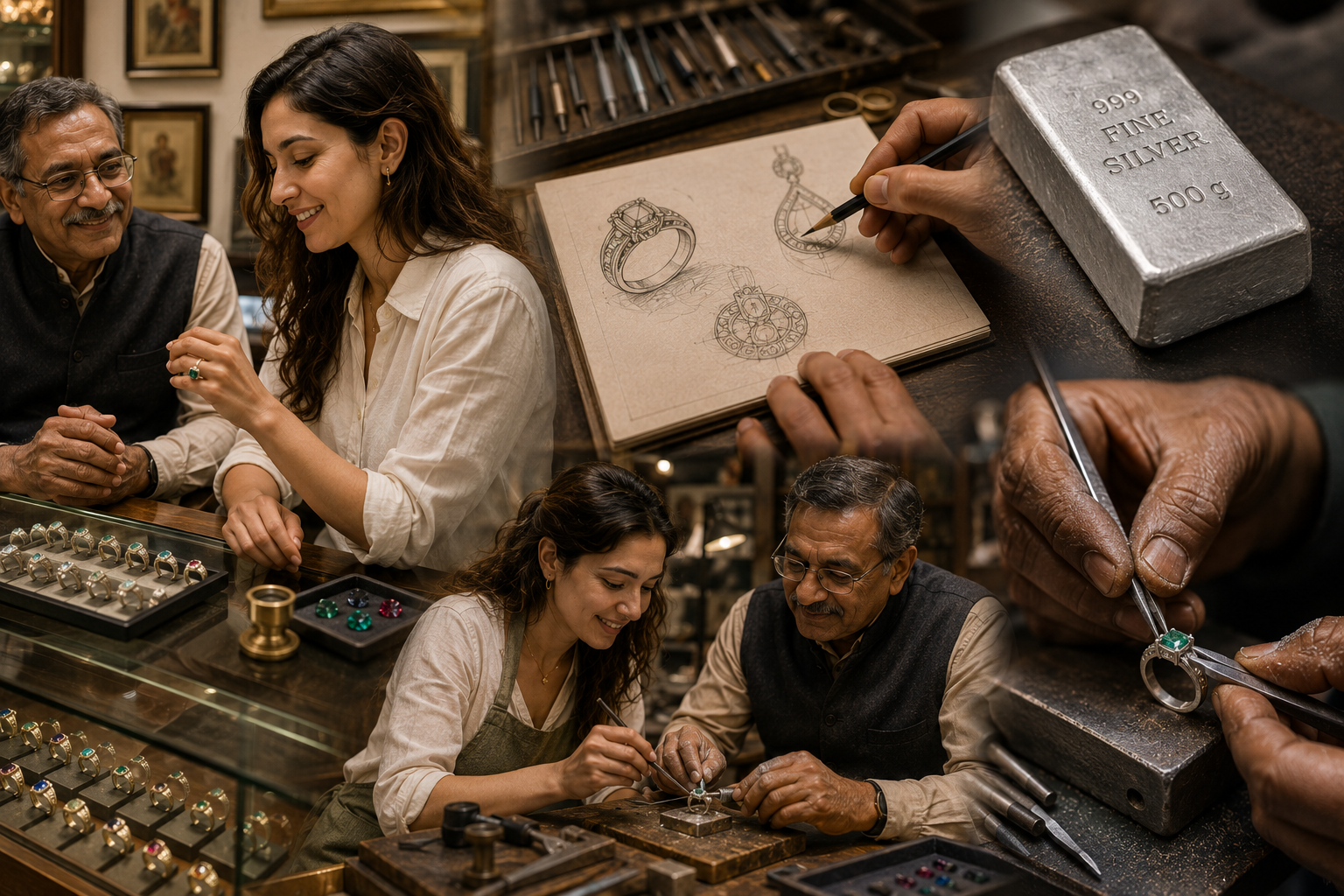
And if you want to understand gemstones not as a buyer but as a maker — to hold them, feel their weight, see them in the context of the setting they belong in — a jewellery making session at the Atelier is the most direct education available.