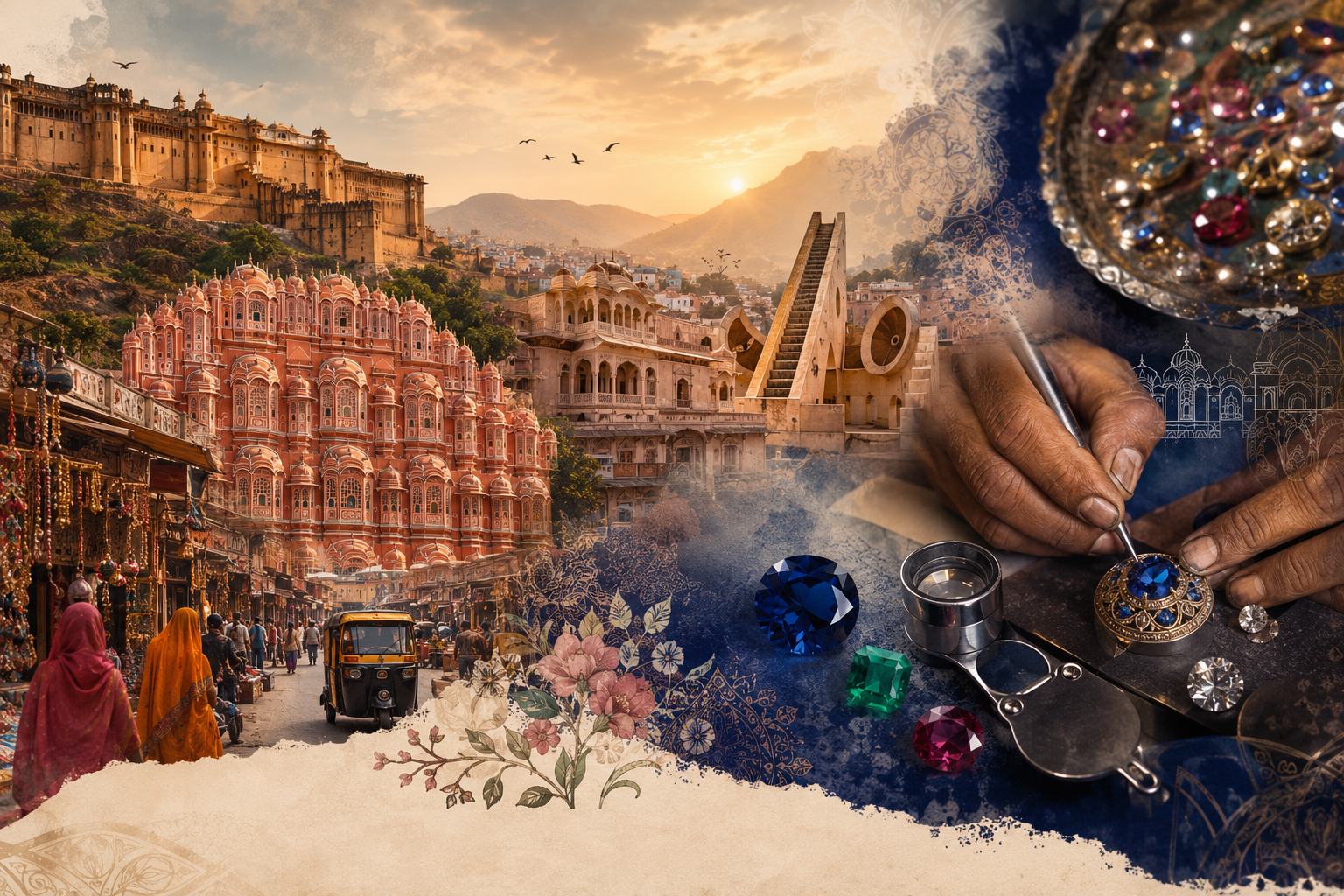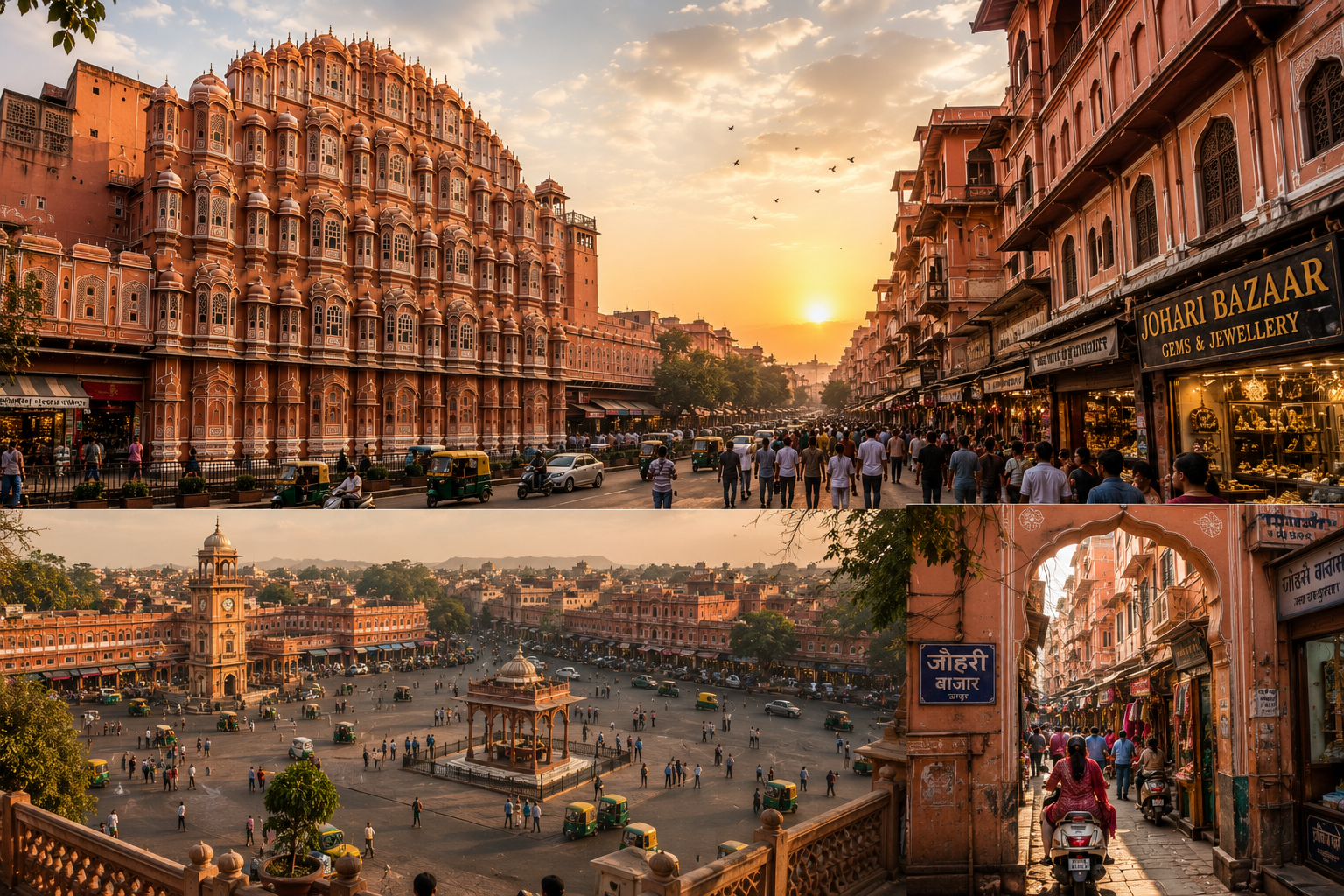
There is a lane in the heart of Jaipur — dusty, narrow, and ancient — where the air smells faintly of metal polish and the light through the windows catches on gemstones the way sunlight catches on water. This is Johari Bazaar, and it has been the centre of India's jewellery trade for nearly three centuries. But how did a city in the middle of the Rajasthan desert become the world's gemstone capital? The story begins in 1727, and it is as remarkable as the stones themselves.
The city built for commerce
Jaipur was not an ancient settlement that grew organically over centuries. It was planned — meticulously, deliberately — by Maharaja Sawai Jai Singh II, one of the most brilliant rulers of 18th-century India. When he moved his capital from Amber to a new city on the plains, he brought with him not just his court and his army, but his craftsmen. Goldsmiths, gem cutters, kundan setters, and meenakari enamelers were given dedicated lanes within the new city's grid. The lane that would become Johari Bazaar — 'johari' meaning jeweller in Hindi — was established from the city's founding year.
Jai Singh understood something that modern economists call 'clustering'. When skilled craftsmen of the same trade work in proximity, knowledge transfers, techniques refine, and quality rises. By concentrating Jaipur's jewellery trade into a single district, he created a centre of excellence that would outlast his reign by three hundred years.
When skilled craftsmen of the same trade work in proximity, knowledge transfers, techniques refine, and quality rises. Jaipur understood this three centuries before the rest of the world did.
The Mughal connection
Jaipur's jewellery heritage did not begin in a vacuum. The Rajput rulers of Rajasthan had long maintained ties with the Mughal emperors in Delhi and Agra, and with those ties came an exchange of artistic traditions. The Mughal court had a refined taste for precious stones — emeralds from Colombia, rubies from Burma, sapphires from Ceylon — and the craftsmen who served them developed extraordinary skills in cutting, polishing, and setting coloured gems.
When Mughal influence began to wane in the 18th century, many of the finest craftsmen drifted south and west, and a significant number found their way to Jaipur. They brought with them the techniques of the imperial workshops: kundan setting, where gems are embedded in pure gold foil pressed between stones; meenakari, the art of enamelling the reverse of a piece with vivid colours; and the precise polishing methods that gave Mughal jewellery its extraordinary clarity.
Why 80% of the world's coloured gemstones pass through Jaipur
Today, Jaipur is estimated to handle between 70 and 80 percent of the world's coloured gemstone trade. Raw stones arrive from mines in Colombia, Mozambique, Madagascar, Sri Lanka, and Myanmar. They are sorted, graded, cut, polished, and either set into jewellery or exported to buyers across the globe. The city is home to over 100,000 people working directly in the gem and jewellery trade.
The reasons for this concentration are partly historical and partly practical. The skills accumulated over three centuries are embedded in families — fathers pass techniques to sons, masters to apprentices. The infrastructure of dealers, cutters, setters, and exporters is so well-developed that a stone purchased at auction in Zambia on a Monday can be cut, polished, graded, and on a plane to New York by Friday.
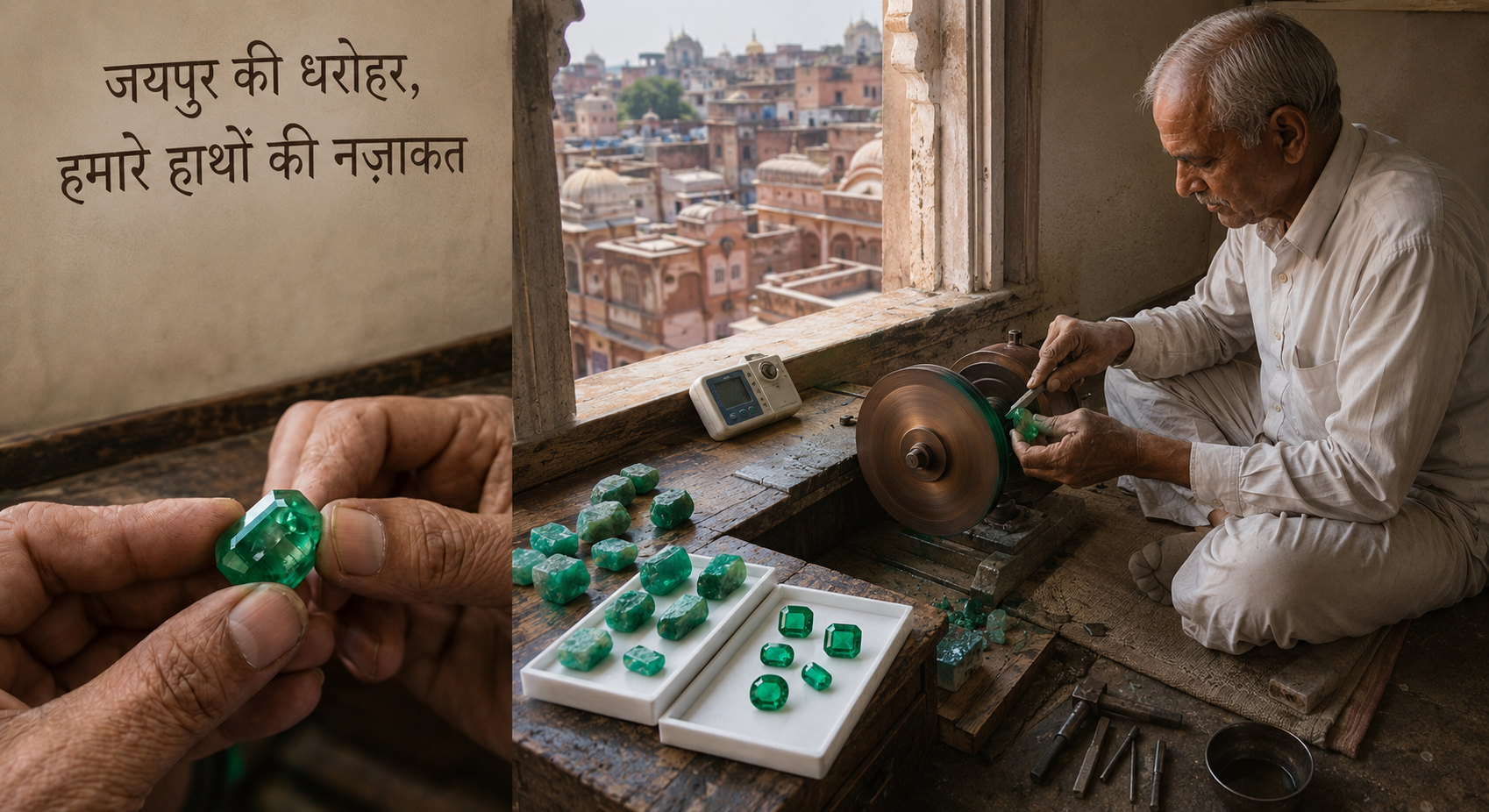
Did you know Jaipur is one of only a handful of cities in the world capable of cutting the finest emeralds. The so-called 'Jaipur cut' — a particular style of faceting that maximises colour depth — is recognised globally as a mark of quality.
The craft traditions that survived
What makes Jaipur exceptional is not just the volume of its trade, but the survival of its hand traditions. Kundan setting — a technique requiring the craftsman to press pure gold foil between individual stones without any adhesive — is still practised today exactly as it was in the 17th century. There is no machine that can replicate it. A master kundan craftsman sits cross-legged at a low wooden bench, his tools spread around him, and works at a pace that looks almost meditative to the uninitiated.
Meenakari, the enamel art that produces Jaipur's famous jewellery reverses — those vivid peacocks and lotus flowers in turquoise and scarlet and white — is equally hand-dependent. The enamel must be applied in precise layers, fired in a small kiln, cooled, and re-fired, with the craftsman reading the colour and texture of the piece at each stage.
These are not museum crafts. They are living trades, practised every day in the workshops of Johari Bazaar by artisans who have trained for years under masters who trained under their own masters. The chain of transmission is unbroken.
These are not museum crafts. They are living trades, practised every day in workshops by artisans who trained under masters who trained under their own masters.
What this means for you
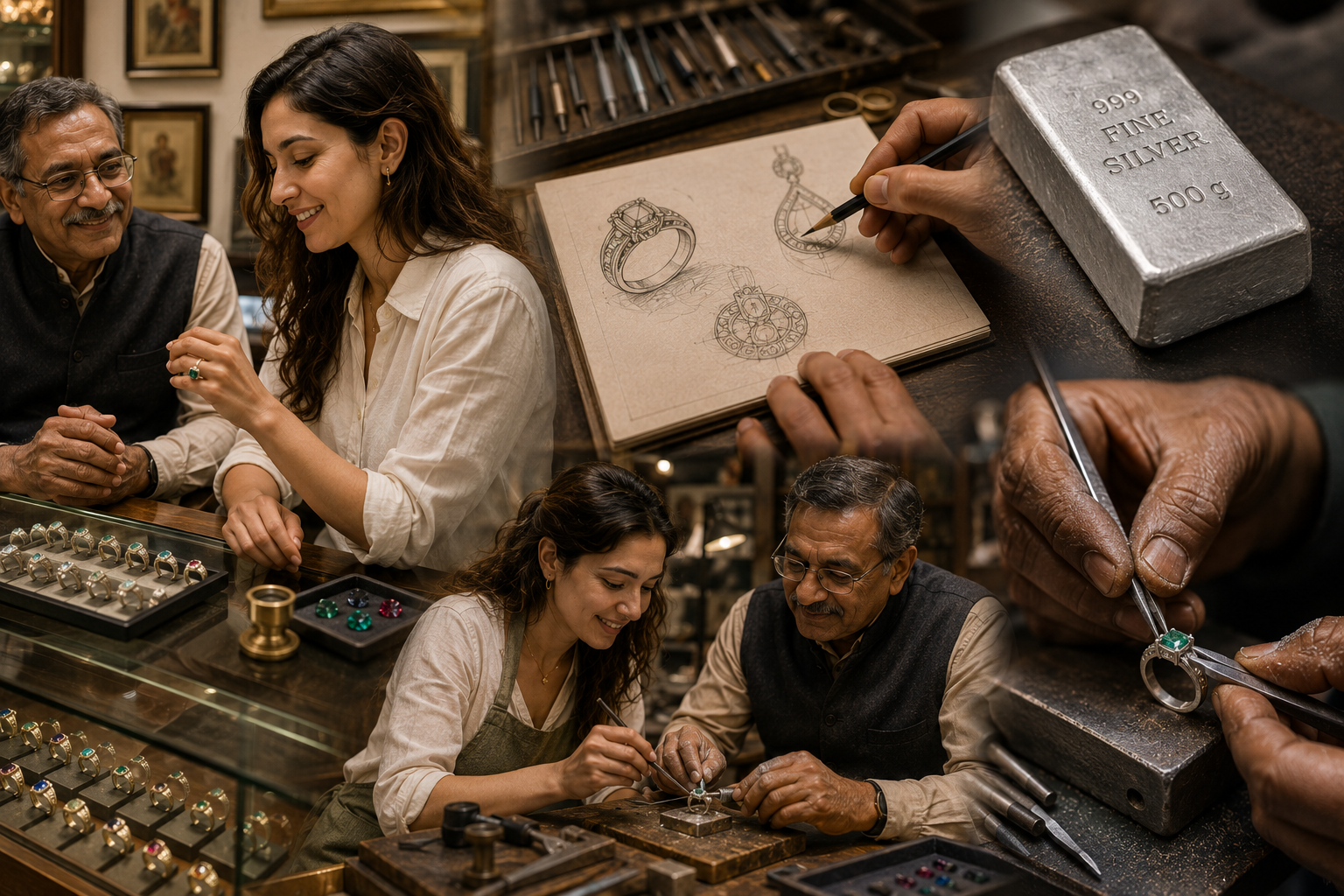
When you walk into a jewellery workshop in Jaipur, you are not simply attending a craft activity. You are stepping into one of the longest-running centres of excellence in the decorative arts anywhere in the world. The artisan sitting across the bench from you may have learned from a man who learned from a man whose teacher sat in the same Johari Bazaar lane during the reign of a Maharaja.
That is not a romantic exaggeration. It is the straightforward truth of what Jaipur's jewellery heritage means. And it is the reason the experience of making something here — with your own hands, guided by a craftsman from this lineage — is unlike anything available anywhere else.